
-
Global Development Overview
Correlation One's workforce development practice for the AI era — programs with USAID, the U.S. Department of State, and government partners, priced on verified jobs and wages instead of people trained.
-
Digital Apprenticeships
U.S. Department of Labor Registered Apprenticeships in data, cybersecurity, and AI roles.

-
Solution overview
Develop the technical skills that Fortune 500 enterprises and the public sector want.
-
Unlock a 100% free pipeline of MENA-trained talent
Access highly skilled professionals trained for real-world enterprise needs — at no cost.
-
Hire Trained Talent
Access pre-trained candidates at zero cost.
 UK
 France
 Germany
 Italy
 Spain
 Poland
 Australia
 Japan
 USA
 Canada



Case study
Mapping durable AI skills across an enterprise AI training portfolio
We audited our own seven AI training offerings against 14 skills and seven questions. What the skill map looks like, the gaps it exposed, and what we now measure.
Who this is for: learning and development leaders, chief AI officers and HR leaders who are auditing an AI training curriculum or deciding what an AI skills framework should contain.
Format Curriculum audit
Offerings audited 7, across 3 levels
Depth scale Introduced, Practiced, Applied
Evidence base 11 studies and frameworks
14
durable AI skills mapped: 8 core and 6 advanced
7
enterprise AI training offerings audited
5
gaps that showed only with the offerings side by side
Context
Why do AI training programs need a durable skills framework? Tool knowledge expires within months, while the judgment to use AI well does not. Without a framework, a curriculum drifts toward features and prompt syntax, and its results get reported as confidence scores. Correlation One saw three problems across enterprise AI training, its own included:
Tool content has a short life. Models, interfaces and features change faster than a curriculum can be rewritten.
Fluent output hides errors. In a Harvard Business School and BCG field experiment with 758 consultants, AI users were 19 percentage points less likely to be correct on a task outside the AI’s capability (Dell’Acqua et al., 2023).
Confidence gets reported as skill. In a study of 319 knowledge workers, higher confidence in generative AI went with less critical thinking (Lee et al., Microsoft Research and Carnegie Mellon, 2025).
Goals
Correlation One audited its own enterprise AI training portfolio to:
Name the AI skills that keep their value as tools change
Show where, and how deeply, each of its seven offerings teaches them
Report demonstrated judgment separately from confidence
Give client conversations, session outlines and slide decks one shared vocabulary for outcomes

Run the same audit on your AI training
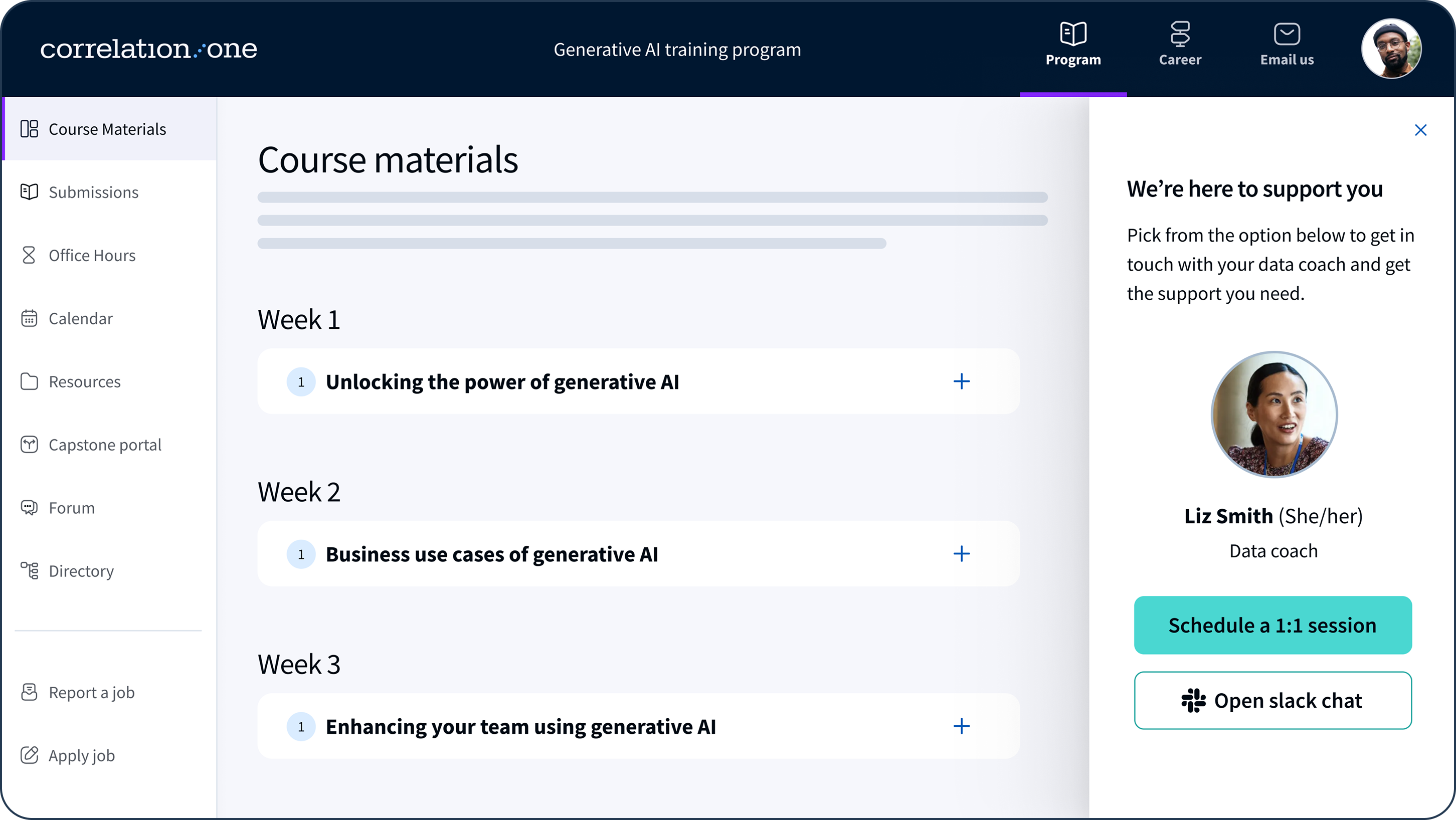
Correlation One designs and delivers AI enablement programs for enterprises, from large-group foundation sessions to workflow redesign labs and executive enablement. We help you:
- Map the AI skills your programs build, and how deep
- Find the gaps no single program review shows
- Report demonstrated judgment separately from confidence
What is the durable AI skills framework?
The framework rests on one claim: AI creates value only when people use it with judgment.
Using AI with judgment means answering seven questions about any piece of AI-assisted work, in three stages. Each question maps to a named core skill. The questions stay the same at every level; what changes is the object: a task at Level 1, a team workflow at Level 2, and a system or strategic AI bet at Level 3.
Decide
Should AI do this?
Delegation judgment — deciding what to hand to AI, what to keep and where human review must sit, based on stakes, reversibility and how checkable the output is
Reimagining solutions — restating a problem as the outcome it serves and redesigning the task or workflow around what AI makes possible
What is it worth, and what does it cost?
Value judgment — judging what AI-assisted work is worth against its cost in time, money and risk, measured against a baseline
Build
How do we steer it?
Direction — giving AI the context, constraints and examples it needs, then refining based on what comes back
How far can we trust it?
Critical evaluation and verification — treating output as a draft until checked against sources, data and domain knowledge, with trust set by the stakes
Own
What else does it change?
Systems thinking — tracing what a change does beyond the task: who receives the output, which handoffs it touches, what it means downstream
Who else should use it?
AI promotion — showing others what worked and helping good practice spread
Who answers for it?
Accountability — owning AI-assisted work as one’s own: using AI within policy, disclosing its use where it matters, knowing who answers for errors

Six advanced skills extend the same questions for two audiences, agentic builders and executives:
Specification (agentic builders) — precise, testable instructions an agent can execute without supervision. Extends: how do we steer it?
Verification architecture (agentic builders) — checks designed into the workflow, such as test cases, evaluation sets and human checkpoints. Extends: how far can we trust it?
Agent orchestration (agentic builders) — splitting work across agents or tool calls and deciding where a person must approve. Extends: should AI do this?
Portfolio judgment (executives) — choosing which AI use cases to fund, scale or stop. Extends: what is it worth, and what does it cost?
Operating-model judgment (executives) — deciding how roles, structures and incentives change as AI absorbs work. Extends: what else does it change?
Governance judgment (executives) — setting the policies, risk thresholds and sign-off rights for where AI may act. Extends: who answers for it?
The framework was cross-checked against Anthropic’s 4D AI Fluency framework (Delegation, Description, Discernment, Diligence) and SHL’s AI readiness factors. It adds two core skills that neither names: value judgment and systems thinking.
How each skill was mapped
Each skill was rated in each offering on a three-step depth scale. A rating counted only if it pointed to a session activity and to evidence a coach or judge could score.
Introduced: named, demonstrated and tried briefly
Practiced: guided practice with coach feedback
Applied: used on participants’ own work and assessed
For every skill and offering, the map records:
Where the skill is taught
What participants do
What evidence could be scored
Whether it comes from an existing outline or is still a draft
The seven offerings span three levels:
SmartScale · Level 1
AI 101 · Level 1
AI 102 · Level 1
AI 201 · Level 2
AI 301 · Level 3
AI Enablement for Executives · Level 3
AI Champions Network · Level 2
Results
What the mapping showed
The map confirmed the weighting the evidence called for, and it exposed gaps that were invisible while each offering was reviewed on its own. Critical evaluation and verification is set at least as deep as any other skill in all seven offerings.
7 of 7
offerings set verification at least as deep as any other skill
5
gaps visible only with the offerings laid side by side
Target depth of each core skill, by offering
Read across a row to see how a skill deepens from one offering to the next.
Introduced named, demonstrated and tried brieflyPracticed guided practice with coach feedbackApplied used on participants’ own work and assessed
| Core skill | SmartScale | AI 101 | AI 102 | AI 201 | AI 301 | Executives | Champions |
|---|---|---|---|---|---|---|---|
| Delegation judgment | Introduced | Practiced | Practiced | Applied | Applied | Practiced | Applied |
| Reimagining solutions | Introduced | Introduced | Practiced | Applied | Practiced | Practiced | Applied |
| Value judgment | Introduced | Introduced | Introduced | Applied | Applied | Practiced | Practiced |
| Direction | Introduced | Practiced | Applied | Applied | Applied | Introduced | Applied |
| Critical evaluation and verification | Introduced | Practiced | Applied | Applied | Applied | Practiced | Applied |
| Systems thinking | Introduced | Introduced | Introduced | Applied | Practiced | Practiced | Practiced |
| AI promotion | Introduced | Introduced | Practiced | Applied | Applied | Practiced | Applied |
| Accountability | Introduced | Introduced | Practiced | Applied | Applied | Practiced | Applied |
AI 301 adds the three agentic-builder skills at Applied depth. AI Enablement for Executives adds the three executive skills at Practiced depth. The Executives and Champions columns are provisional: the executive outline is under review and the champions mapping has not yet been checked against a session outline.
Five gaps, and what is changing
Five gaps appeared only when the offerings were laid side by side. Each one now has a change in design.
| What the map showed | Change in design |
|---|---|
| Early activities started from friction in the current task, so participants improved a step without asking whether the step should exist | A “start from the result” prompt in foundation sessions, and a “remove this step” option beside automate now, automate later and keep human in the AI 201 workflow triage |
| No offering asked participants to explain an AI output before accepting it | At least one activity per offering where participants explain an output in their own words first |
| No offering checked the skill without AI present | One short unassisted task per offering, such as spotting the error in a printed output |
| Foundation offerings never tested whether AI saved time or improved quality | A before-and-after check on time and quality, so participants compare what it felt like with what it was |
| Workflow redesign looked inside the team’s own process, not at the teams that receive its output | Mapping of inputs received and downstream consumers during scoping, plus a pre-mortem on exceptions where a valid AI decision is wrong in context |
Two further changes apply to the advanced offerings. Agent testing in AI 301 gains a red-team pass, where peers probe an agent for biased outcomes and try to make it misbehave. AI Enablement for Executives is proposed as a sequence of sessions, with a discernment exercise the executives complete themselves.
These are design changes, not results. None has yet been measured across a client cohort, and this case study will be updated when they have.
How should durable AI skills be measured?
By scoring what people do with AI output, and reporting that score separately from self-rated confidence. Confidence is not capability: people who cannot inspect AI output cannot rate that gap in themselves.
The mapping showed that measurement differed by offering. Foundation offerings reported satisfaction and confidence. Only the two lab offerings judged demonstrated skill.
| Offering | Measured before the mapping | What it shows | Proposed change |
|---|---|---|---|
| AI 101 | Self-rated confidence, before and after, and intended frequency of use | Confidence | Add a judgment item now, then replace confidence items with a scored catch task: find the error in an AI output |
| AI 102 | Not yet built | Not yet built | Timed before-and-after task audit and rubric-scored work samples, with a judgment score beside speed |
| AI 201 | Showcase judging, session ratings, and a before-and-after experience ladder | Demonstrated skill, satisfaction and confidence | Report Showcase scores as their own line, and add a judged review of the artifact |
| AI 301 | Showcase judging on value, flow and logic, governance and security design, and delivery | Demonstrated skill | Add the unassisted check |
| AI Enablement for Executives | Experience rating | Satisfaction | Keep, and add one decision-quality item only where a session calls for it |
Two rules apply to every offering:
Measure against a baseline. In a METR study, 16 experienced developers took 19% longer with AI while believing they were faster (METR, 2025, updated 2026). Self-reported productivity is not a reliable measure.
Frame scored tasks as developmental. Only 27% of US workers in an SHL survey fully trust their employer to use AI responsibly (SHL, 2025). Participants are told what a scored task is for, who sees the results and what happens with them.
What does the evidence say about how these skills are built?
Durable AI skills are built on real work, with feedback, with manager support, and with AI use that keeps the person thinking. Four findings shaped the design:
Verification drops when output looks finished. Anthropic’s AI Fluency Index, a study of 9,830 conversations, found users were less likely to check facts when the AI produced a polished artifact (Anthropic, 2026). Verification is trained hardest where output looks most complete.
Explaining beats substituting. In a randomized trial of 52 mostly junior engineers, the AI-assisted group scored 50% on a comprehension quiz against 67% for the unassisted group (Shen and Tamkin, Anthropic, 2026). Stronger performers used AI to build understanding, not only to produce code.
Generic training transfers weakly. Critical-thinking instruction works better when it combines dialogue, authentic problems and mentoring (Abrami et al., 2015), and supervisor support predicts whether training transfers to the job (Blume et al., 2010).
Leadership support moves adoption. Positive sentiment about generative AI rises from 15% to 55% where employees have strong leadership support (BCG, AI at Work 2025). This supports teaching AI promotion as a core skill and sequencing executive enablement.
The framework also separates durable AI skills from two neighbors. Tool-specific skills sit on top and expire fast, so they are refreshed just in time. Domain expertise sits underneath and is what makes checking AI output possible.
What can L&D and business leaders take from this?
Any organization can run the same audit on its own AI training in five steps:
Start from questions, not tools. List the questions a person must answer about AI-assisted work. The seven used here: should AI do this, what is it worth, how do we steer it, how far can we trust it, what else does it change, who else should use it, and who answers for it.
Name one skill per question. Keep the core set small. A short list that deepens by level is easier to teach and to measure than a long competency catalog.
Rate depth honestly. For each program, mark each skill as Introduced, Practiced or Applied, and require a named activity and scoreable evidence for every rating.
Lay the programs side by side. Gaps that no single program review finds become visible in the grid, such as a skill that is never tested without AI.
Change what gets reported. Report demonstrated judgment and confidence as separate lines, and measure time and quality against a baseline.
Three cautions apply. Weight verification highest, because it has the strongest evidence and is what people drop first when output looks polished. Adjust emphasis by cohort: SHL’s assessment data suggests early-career workers know the tools but need more work on evaluation, while seasoned professionals have the judgment but find it harder to reimagine a solution from scratch (SHL, 2026). Treat short sessions as entry points into a longer path, not as the path.
FAQ
Frequently asked questions
- What is an AI skills framework?
- An AI skills framework is a named set of skills people need to work well with AI, with a definition and a way to observe each one. Correlation One’s framework has eight core skills, tied to seven questions about any piece of AI-assisted work, and six advanced skills for agentic builders and executives.
- How do you audit an AI training curriculum?
- Audit an AI training curriculum by listing the skills it should build, then rating each program on each skill as Introduced, Practiced or Applied. Require a named activity and scoreable evidence for every rating. Compare programs side by side to find skills that are never practiced, never assessed, or never tested without AI.
- Which AI skill should training weight most heavily?
- Critical evaluation and verification should carry the most weight. It has the strongest empirical support, and it is the skill people drop first when AI output looks polished. In Correlation One’s map it is set at least as deep as any other skill in all seven offerings.
- How do durable AI skills differ by seniority?
- The seven questions are the same at every level, but the object changes. Individual contributors ask them of a task. Teams ask them of a workflow. Executives ask them of a system or a strategic AI bet, which adds portfolio, operating-model and governance judgment.
- How is this different from Anthropic’s 4D AI Fluency framework?
- Anthropic’s 4D framework names Delegation, Description, Discernment and Diligence. Correlation One’s framework maps to all four and adds skills for the decisions around the work: value judgment, systems thinking, AI promotion, and the advanced skills for agentic builders and executives.
- Does a confidence gain show that AI training worked?
- No. A confidence gain shows that participants feel more able, not that their judgment improved. Research from Microsoft and Carnegie Mellon found that higher confidence in generative AI went with less critical thinking. Report a scored task beside the confidence result.
- How long does it take to build durable AI skills?
- Durable AI skills build over repeated practice on real work, not in one session. A foundation session can introduce the skills. Applying them takes coached work on a participant’s own tasks or workflows, followed by manager support back on the job.
Sources
- Dell’Acqua et al., Harvard Business School and BCG (2023): field experiment with 758 consultants
- Lee et al., Microsoft Research and Carnegie Mellon (CHI 2025): survey of 319 knowledge workers
- Anthropic: AI Fluency Index (2026)
- Shen and Tamkin, Anthropic (2026): randomized trial with 52 engineers
- METR: developer productivity study and update (2025, 2026)
- BCG: AI at Work 2025
- SHL AI readiness assessment (2026) and SHL trust survey (2025)
- Abrami et al., 2015, meta-analysis of critical-thinking instruction; Blume et al., 2010, meta-analysis of training transfer
- Correlation One, durable AI skills map by offering, November 2026
News and resources