

.png?width=207&height=108&name=Mega%20menu%20%E2%80%93%20Featured%20Image%20Template%20(1).png)
 UK
UK
 France
 Germany
 Italy
Italy
 Spain
Spain
 Poland
.svg) Australia
Australia
 Japan
Japan
 USA
USA
 Canada



A Correlation One Intelligence Report2026
AI investment ROI in 2026 is not determined by how much enterprises spend on licenses or how many pilots they launch — it is determined by whether tool investments and workforce enablement are integrated into a single, measured system. That is the central finding from Correlation One's client engagements across 10+ industries in the first half of 2026.
Quick answer: What is the state of enterprise AI enablement in 2026?
Enterprise AI adoption has entered its accountability phase. The dominant question in executive conversations is no longer "which AI tools should we buy?" but "why hasn't the ROI shown up — and what do we do about it?" Based on Correlation One's H1 2026 client engagements:
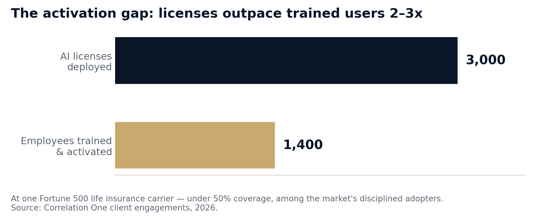
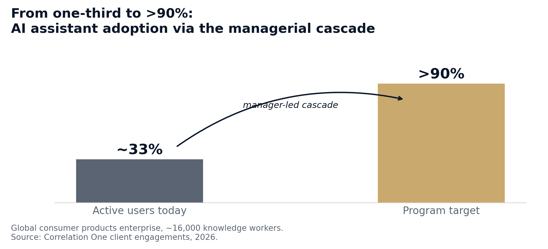
- The activation gap is the biggest hidden cost in enterprise AI. Enterprises typically hold 2–3x more AI licenses than trained, active users. At one global consumer products enterprise with ~16,000 knowledge workers, only about one-third were active users of the deployed AI assistant.
- There is no single AI journey. Enterprises cluster into five distinct archetypes — Licensed but Latent, Pilot Theater, the Progression System, the Managerial Cascade, and the Operating-Model Redesign — each with a different failure mode and a different fix.
- Executive engagement is the strongest ROI multiplier. C-suite involvement has shifted from sponsorship to hands-on participation — and outcomes are measurably better where executives are highly engaged, because the decisions that block AI at the pilot-to-production boundary are executive decisions.
- Enterprises have adopted a prove-before-scale posture. The disciplined, instrumented first program has replaced the big-bang AI transformation mandate — and the most advanced AI capability programs compound from a small proving phase into embedded, multi-year academies over 18–24 months.
- Prompting — not risk awareness — is the No. 1 measured skill gap at every enterprise Correlation One trains.
- Measurement has become a purchase criterion. Buyers now ask what will be baselined, how usage will move, and what cohorts will ship — before programs begin.
01Why do most enterprise AI investments fail to show ROI?
Most enterprise AI investments fail to show ROI because tools are deployed without activation, and pilots are launched without a path to production. The strongest predictor of realized AI ROI in Correlation One's client engagement data is not budget size — it is the balance between decentralized innovation (letting employees discover and build) and governance discipline (measuring, standardizing, and scaling what works), combined with tight integration between tool spend and workforce training.
Two failure patterns dominate:
- The activation gap. Enterprises purchase AI licenses at scale, run a launch webinar, and watch monthly active usage settle at 25–50%, concentrated among natural enthusiasts. At a Fortune 500 life insurance carrier, roughly 1,400 employees had completed structured enablement against ~3,000 deployed Copilot licenses — under 50% coverage, and that carrier is one of the disciplined ones. Unactivated licenses are plausibly the single largest source of stranded AI investment in the enterprise today — and the cheapest to fix, because activating an existing license costs a fraction of the license itself.
- Pilot theater. A growing inventory of proofs-of-concept that never cross into production. Because nothing ships, nothing generates defensible ROI; because nothing generates ROI, budgets and credibility erode just as the underlying technology matures.
02What are the five flavors of the enterprise AI journey?
Correlation One's client engagements show enterprises cluster into five recognizable archetypes. Diagnosing the right one matters more than benchmarking against an abstract maturity curve, because each flavor requires a different intervention:
| Flavor | Signature | Failure mode | The unlock |
|---|---|---|---|
| 1. Licensed but Latent | Tools deployed at scale, 25–50% active usage | Leadership concludes "AI is overhyped" when the tool was never activated | Structured, live activation programs measured by usage movement, not attendance |
| 2. Pilot Theater | Dozens of demos, no production deployments | Excitement without scale; ROI never measured | Ruthless use-case pre-filtering and a standard pilot-to-production path |
| 3. The Progression System | Tiered academy: 101 → 102 → 201 → 301 | Tiers treated as a course catalog, not a managed funnel | Manage conversion ratios explicitly (~100% / 30% / 10%) |
| 4. The Managerial Cascade | Manager-led, layer-by-layer behavior activation | Framed as comms campaign; decays at middle management | Playbooks, guided activities, and accountability rhythms per management layer |
| 5. The Operating-Model Redesign | Business units redesigned around human-AI workflows | Blueprints without the fluency base to operate them | Sequence top-down redesign sprints with bottom-up capability building |
The most consequential mistake in the market is buying the intervention for the wrong flavor — a Pilot Theater organization purchasing more licenses, or a Licensed-but-Latent organization commissioning an operating-model redesign it cannot absorb.
.png?width=548&height=237&name=fig3-ai-enablement-progression-100-30-10%20(1).png)
03How does C-suite engagement affect AI investment ROI?
C-suite engagement is the strongest AI ROI signal Correlation One observes across client engagements: outcomes are materially better where executives participate hands-on rather than merely sponsor. Executive involvement has visibly shifted — in 2024 the C-suite approved AI budgets; in 2025 it commissioned roadmaps; in 2026, executives are increasingly in the room, with leadership AI enablement programs, executive learning labs, and future-ready-leader workshops appearing across a majority of new engagements — often as the first thing an enterprise asks for.
Why does executive engagement move the ROI needle? Three mechanisms:
- Adoption is hierarchical. Team-level AI usage tracks manager usage, and manager behavior tracks what leadership visibly models. A hands-on C-suite rewires the permission structure of the organization — AI stops being an optional experiment and becomes "how we work here."
- The decisions that block scale are executive decisions. Data access, risk sign-off, cross-functional process change, and next-phase funding all sit at the executive layer. Engaged executives unblock in weeks what sponsor-only organizations take quarters to escalate.
- Fluent executives fund better use cases. Leaders who have personally built with the tools can tell a demo from a workflow — and they stop funding pilot theater.
The highest-performing executive programs follow a two-wave journey: wave one builds personal fluency (executives complete the same hands-on activities as their teams), and wave two applies it to workflow redesign (each executive re-architects how their own function operates, with outputs feeding directly into what employee cohorts build next).
"Executive sessions that skip straight to strategy produce sponsors who cannot model the behavior they are sponsoring."
What high engagement looks like: executives attend as learners; share their own AI use cases — including failures — publicly; judge cohort demo days and attach real recognition to shipped artifacts; own a workflow-redesign target inside their own function; and review AI adoption metrics at the QBR level, not buried in an L&D report. The anti-pattern is equally recognizable: the sponsor-only executive who records a kickoff video and never touches the tools. Employees decode the real message instantly — and no volume of training investment below the executive layer fully compensates for a disengaged one above it.
04How are enterprises structuring their AI enablement journeys in 2026?
Enterprises have converged on a prove-before-scale posture. First AI enablement programs now share a compact shape — executive fluency sessions plus one or two flagship cohorts, instrumented with baseline and post-program skills measurement — explicitly designed to generate internal proof before any commitment to scale. The speculative, enterprise-wide AI transformation mandate has given way to the disciplined pilot-to-proof program. That is a sign of maturity, not hesitation: enterprises have learned that unproven scale is how AI investments strand.
The journey then compounds through three phases:
| Phase | What it looks like | What triggers it |
|---|---|---|
| Prove | Executive fluency sessions; 1–2 flagship cohorts; baseline skills measurement | Board pressure to show an AI plan; stranded license spend |
| Scale | Multi-cohort academies; manager cascades; team-level agent-building programs | Measured results from the proving phase |
| Embed | Multi-year academy partnerships: tiered progression, innovation labs, redesign sprints, talent competitions | AI capability reclassified from an L&D initiative to an operating-model program |
The most advanced AI capability programs in Correlation One's client engagements did not begin as large programs — they compounded from a well-instrumented proving phase over 18–24 months.
Which industries are moving fastest? Financial services and insurance represent roughly 35–40% of enterprise AI enablement demand — a concentration driven by dense knowledge workflows, regulatory pressure to govern AI properly, and cultural comfort with measurement. Healthcare and life sciences form the clear second wave, followed by energy, industrials, education, consumer goods, and technology. The newest entrant: sovereign and public institutions — central banks, national cybersecurity agencies, and multilateral organizations are now commissioning workforce-scale AI capability programs, treating national AI readiness as a talent problem before a technology problem.
Typical ratio of deployed AI licenses to trained users across client engagements
Share of knowledge workers actively using the deployed AI assistant at one 16,000-person enterprise
Share of enterprise AI enablement demand from financial services and insurance
05Which AI skills gaps are holding back enterprise ROI?
Because Correlation One measures skills before and after every program, its instructors see what employees can actually do — not what leaders believe they can do. Four signals from live 2026 engagements:
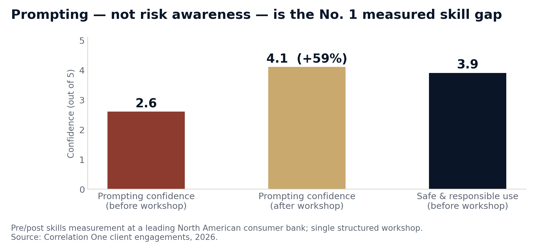
- Prompting is the No. 1 skill gap at every enterprise. At a leading North American consumer bank, pre-workshop prompting confidence measured 2.6 out of 5 — versus 3.9 for safe and responsible use. After one structured workshop, prompting confidence jumped 59%, the largest gain of any measured dimension. Enterprises over-invest in risk messaging employees have already absorbed and under-invest in the operating skill that determines whether tools produce value.
- "Citizen Developer" is now a named, credentialed role. At a multinational airline group, 40 non-technical employees built 11 production AI agents in seven weeks — covering expense reconciliation, contract-clause review, pricing-list digitization, and executive-insight summarization. A semiconductor manufacturer has formalized a three-tier persona model (Business User, Citizen Developer, Power User) with escalating build permissions.
- Capstones with production deliverables are now baseline, not differentiator. Recent production-bound outputs include an onboarding-checklist agent heading to a 5,000-associate rollout at a top-ten US bank and a quality-control documentation agent freeing an estimated 80 hours per month for a payments-processing team. The simplest quality screen for any training partner: ask what their last three cohorts shipped.
- The evaluation gap is creating a new category of work. The skill enterprises most assume their employees have — knowing when an AI output is wrong in a way that matters — is the one instructors most consistently find missing. Leading adopters are building formal agent-testing frameworks (accuracy in scope, graceful refusal out of scope), and the gap is spawning a fast-growing category of AI review and quality-assurance roles.
06What do enterprises with real AI ROI do differently?
Seven practices consistently separate AI ROI leaders from laggards in Correlation One's client engagements:
- Close the license-to-activation gap first. If active usage is under ~70% of deployed seats, activation — not new tooling — is the highest-ROI investment available.
- Design enablement as a progression system, not an event. Universal fluency at the base; team agent-building for the ~30% who advance; power-user depth for the ~10% who will carry automation into every business unit.
- Make managers the delivery mechanism. Team-level AI adoption tracks manager adoption. One global consumer enterprise is using a manager-cascade model to move usage from roughly one-third of 16,000 knowledge workers toward a >90% target.
- Demand production artifacts from every program. If a cohort doesn't ship a working agent, redesigned workflow, or measured productivity delta, it was theater.
- Teach evaluation as deliberately as generation. Trust in AI output is an organizational capability, not an individual instinct.
- Run executives on their own sequenced journey — personal fluency first, workflow redesign second.
- Instrument everything. Baseline skills before training, measure after, tie outputs to workflow metrics. The enterprises that measure are the ones whose AI capability compounds year over year.
07Frequently asked questions
What is AI enablement?
AI enablement is structured, instructor-led training that builds applied AI capability against an enterprise's real tools, data, and workflows — as distinct from self-paced course licensing. Effective enablement programs are tiered (fluency → agent building → power users), manager-activated, and measured with pre/post skills data and production deliverables.
How is AI enablement ROI measured?
Leading enterprises measure AI enablement ROI through four instruments: usage analytics movement (active users vs. deployed licenses), pre/post skills measurement, production artifacts shipped per cohort (working agents, redesigned workflows), and workflow-level productivity deltas (e.g., an agent saving ~80 hours per month for a single team).
What is the AI activation gap?
The AI activation gap is the difference between the number of AI licenses an enterprise has deployed and the number of employees trained and actively using them. Enterprises typically carry 2–3x more licenses than trained users, making unactivated licenses one of the largest sources of stranded AI investment — and one of the cheapest to fix.
Why does executive engagement matter for AI ROI?
Because AI adoption is hierarchical and the decisions that block scale are executive decisions. Team-level AI usage tracks manager usage, which tracks what leadership visibly models — and data access, risk sign-off, and next-phase funding all sit at the executive layer. Enterprises where the C-suite participates hands-on (rather than only sponsoring) see faster activation, deeper adoption cascades, and far higher pilot-to-production conversion.
What is a Citizen Developer?
A Citizen Developer is a non-technical employee trained to build working AI agents using platforms like Copilot Studio, Custom GPTs, or Gemini Gems. It has become a formally credentialed role — with certificates, badges, and progression paths — inside multiple Fortune 500 enterprises.
What is the AIM Index?
The AI Impact and Maturity (AIM) Index is Correlation One's executive diagnostic of enterprise AI readiness. It scores organizations 0–100 across four dimensions — Maturity, Impact Potential, Talent, and Momentum — and places them on a five-stage ladder from Lagging to Embedded, with maturity (governance, ROI tracking, executive oversight) weighted most heavily because it is the strongest predictor of sustained ROI.
The insights in this article come from Correlation One's client engagements — live enterprise AI enablement programs delivered in the first half of 2026 across North America, Europe, Latin America, the Middle East, and Asia-Pacific. Skills findings are drawn from pre- and post-program measurement inside those engagements and from Correlation One's assessment platform, which has evaluated more than 500,000 individuals across 50+ countries. Client-identifying details are anonymized except where engagements are already public.
Correlation One is an AI and data workforce development company serving enterprises including Amazon, Citadel, Micron, Pacific Life, Coca-Cola, Colgate-Palmolive, and New York Life, as well as the U.S. State Department and the U.S. Department of Defense. The company has trained 500,000+ professionals, works with 3,000+ global AI domain experts, and maintains 500+ employer engagements across 50+ countries. Its programs have generated $1 billion+ in documented client productivity gains, with 1,000+ verified reviews averaging 4.93/5 on Course Report.
Ready to see where your organization stands?
Take the AIM Assessment to get your AIM Index score, stage placement, and a prescriptive roadmap.
Talk to our team